
Rummy Noble Legality
Online rummy in India exists within a unique legal environment where the key distinction is not about gambling in general, but about whether a game is classified as skill-based or chance-based. This distinction determines how the law applies across different states.
Indian courts, including the Supreme Court of India, have repeatedly recognized that rummy involves a significant degree of skill. Players must apply memory, strategy, probability assessment, and decision-making to succeed. Because of this, rummy is generally treated as a game of skill, which places it in a legally different category from pure gambling activities.
However, the legal status is not uniform across the country. India follows a federal structure, meaning each state has the authority to regulate or restrict real-money gaming activities independently. As a result, legality depends heavily on where the player is physically located.
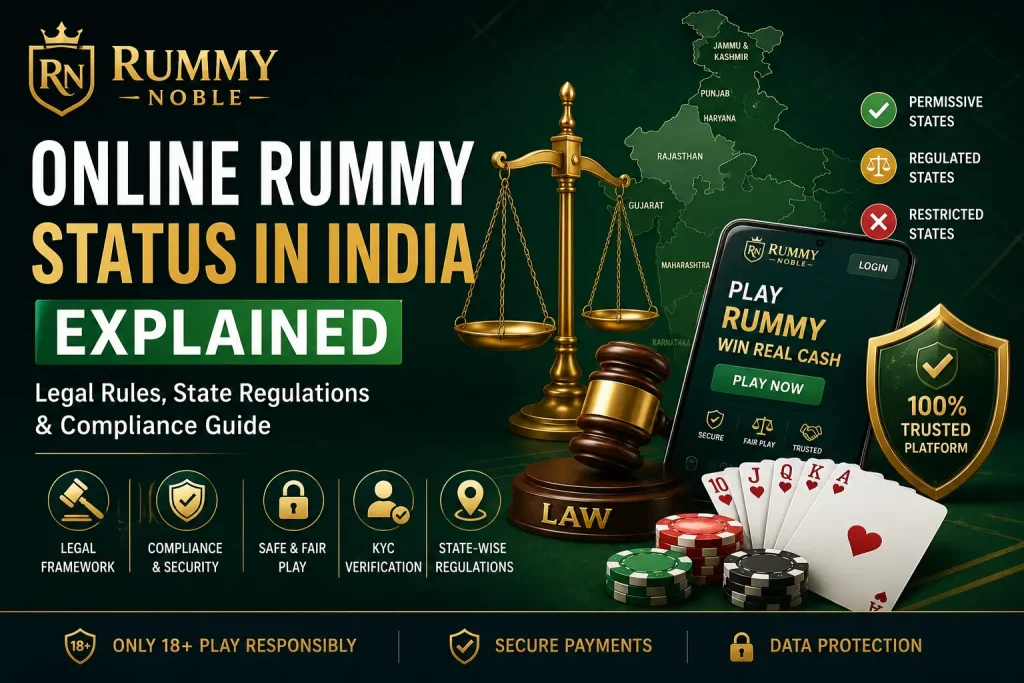
Most states allow skill-based gaming, while a smaller number impose restrictions on real-money participation. This creates a compliance-driven ecosystem where platforms like Rummy Noble must actively ensure users can only access services from permitted jurisdictions.
To maintain compliance, platforms typically implement:
- Geo-blocking systems
- KYC (Know Your Customer) verification
- Age restrictions (18+)
- Responsible gaming tools
Modern platforms also rely on structured onboarding flows such as Login authentication, Sign Up verification, Bonus distribution systems, APK-based mobile access, and in-app Game categories including Slots (where legally permitted). These systems are not just technical features—they are part of legal compliance infrastructure.
Legal Classification Overview
| Category | Legal Interpretation in India | Effect on Platforms |
|---|---|---|
| Rummy (Skill Game) | Recognized as legal skill-based game | Allowed in most states with conditions |
| Chance-based Gambling | Restricted or prohibited | Cannot be offered in many jurisdictions |
| Online Real-Money Gaming | Regulated at state level | Requires geo-restriction systems |
| Operator Compliance | Mandatory in regulated environments | KYC, AML, and responsible gaming enforced |
The core principle shaping online rummy legality in India is simple:
Skill-based games are generally permitted, but regulated at the state level.
This means platforms like Rummy Noble must continuously adapt to regional laws while maintaining fairness, transparency, and user protection standards.
State Regulations & Legal Enforcement for Online Rummy in India
India’s online gaming legality is not controlled by a single centralized law. Instead, it is shaped by a combination of national-level principles and state-specific gambling regulations. This creates a layered legal structure where compliance depends heavily on geography.
The foundation remains the Public Gambling Act of 1867, but modern interpretation has evolved significantly due to digital gaming growth. Courts have consistently separated games of skill (like rummy) from gambling activities, which allows regulated platforms to operate legally in most jurisdictions.
However, the key complexity lies in state autonomy. Each Indian state can independently decide whether to allow, restrict, or ban real-money online gaming. This leads to three major categories of regulation:
- Fully allowed skill-based gaming states
- Restricted or partially regulated states
- Fully prohibited real-money gaming states
To remain compliant, platforms like Rummy Noble must implement strict technical controls such as:
- Geo-location verification
- Automatic blocking of restricted states
- Secure financial transaction monitoring
- Age verification and identity checks
Additionally, user flows include essential access points such as Login, Bonus activation systems, Sign Up verification, APK downloads, Games selection modules, Slots (where applicable), and external Links routing systems. These are not just UX features but also compliance checkpoints.
State-Level Legal Classification
| Category | Description | Example Status |
|---|---|---|
| Fully Permissive States | Allow skill-based real-money games | Rummy permitted with compliance rules |
| Partially Regulated States | Allow gaming with restrictions | Time, tax, or license-based limitations |
| Restricted States | Ban real-money online gaming | Access blocked via geo-fencing |
Legal Accessibility Distribution
Legal Insight for Operators & Players
The biggest compliance challenge is not legality itself, but consistency across jurisdictions. A platform like Rummy Noble must continuously adapt to state-level changes, ensuring that:
- Users cannot access services from restricted regions
- Transactions comply with financial regulations
- Game integrity remains verifiable and transparent
This regulatory fragmentation is why modern platforms invest heavily in automated compliance systems and real-time monitoring.
Compliance Risks, Legal Interpretation & Platform Responsibility
The legal environment for online rummy in India is not only defined by whether the game is allowed or restricted, but also by how strictly regulations are interpreted and enforced in practice. Even in states where skill-based gaming is permitted, operators must comply with multiple layers of digital, financial, and identity verification laws.
A key factor in legal compliance is risk categorization, which determines how accessible a platform is in each regulatory environment. This includes:
- Legal recognition of skill-based games
- Financial transaction monitoring requirements
- Geo-restriction enforcement strength
- User verification obligations (KYC/AML)
Platforms like Rummy Noble operate within this structure by enforcing strict internal controls. These include Login authentication systems, Bonus eligibility validation, Sign Up KYC checks, APK-based secure installation flows, Games access filtering, and controlled Links routing systems. Each layer reduces legal exposure and ensures compliance consistency.
From a regulatory perspective, India does not treat all states equally. Some states apply relaxed interpretations of skill gaming laws, while others impose strict bans on real-money gaming. This creates a risk distribution model rather than a single unified law.
Regulatory Risk Classification
| Category | Risk Level | Platform Requirement |
|---|---|---|
| Permissive States | Low | Standard KYC & geo-check |
| Regulated States | Medium | Strict verification & monitoring |
| Restricted States | High | Full access blocking (geo-fencing) |
Legal Risk Distribution
The Indian online rummy ecosystem is best understood as a tiered compliance system, not a binary legal/illegal structure. Platforms must continuously adjust to:
- State-level legal interpretation differences
- Evolving digital payment regulations
- User identity verification requirements
- Real-time geo-restriction enforcement
This is why compliance architecture is as important as gameplay design itself in platforms like Rummy Noble.
Even though rummy is widely recognized as a skill-based game, legality in practice depends on continuous enforcement of responsible gaming standards and regulatory alignment. This is where operational compliance becomes more important than theoretical legality.
Modern platforms like Rummy Noble operate within a structured ecosystem that includes identity verification, financial monitoring, and gameplay fairness systems. These are designed not only to meet legal requirements but also to ensure long-term sustainability in regulated digital markets.
Key operational pillars include:
- Strict age verification (18+ only access)
- KYC (Know Your Customer) identity validation
- Anti-money laundering (AML) monitoring systems
- Geo-restriction enforcement for blocked regions
- Transparent bonus and reward distribution systems
- Secure APK-based installation and update validation
- Controlled access to Games, Slots (where permitted), and external Links
Each of these systems contributes to maintaining compliance across different Indian jurisdictions while ensuring a consistent user experience.
Another important aspect is responsible gaming architecture. Platforms are expected to prevent excessive play behavior, provide self-exclusion tools, and ensure that users have access to spending limits and session tracking features.
Platform Compliance Framework
| Compliance Area | Purpose | Implementation Method | Legal Impact |
|---|---|---|---|
| KYC Verification | User identity validation | ID + phone + bank verification | Ensures lawful participation |
| Geo-Blocking | Restrict banned regions | IP + GPS location tracking | Prevents legal violations |
| AML Monitoring | Prevent financial misuse | Transaction pattern analysis | Aligns with financial regulations |
| Responsible Gaming | Prevent addiction & misuse | Limits, timers, self-exclusion tools | Ethical compliance requirement |
| Game Fairness Systems | Ensure RNG integrity | Algorithm audits & randomization checks | Builds legal trust & transparency |
The legality of online rummy in India is not a single rule but a multi-layer compliance ecosystem. It is defined by:
- Court recognition of skill-based gaming
- State-by-state regulatory differences
- Platform-level compliance infrastructure
- Continuous enforcement of responsible gaming policies
In this environment, legality is not just about permission—it is about ongoing operational discipline and transparency.
Platforms like Rummy Noble remain compliant by integrating legal requirements directly into user flows such as Login, Sign Up, Bonus systems, APK installation processes, and Games access logic. This ensures that compliance is not separate from gameplay but built into the core architecture of the platform.