
Rummy Noble Education
Online card gaming in India has evolved from casual entertainment into a structured skill-based ecosystem where learning plays a central role. On platforms like Rummy Noble, education is not treated as an optional feature—it is the starting point of the entire user journey. Before players enter competitive tables, they are encouraged to understand mechanics, patterns, and strategic thinking.
Rummy is not just a game of chance. While card distribution is random, the outcome is heavily influenced by how well a player understands sequencing, probability, and decision-making. This is why structured education becomes essential, especially for beginners who are entering digital card gaming for the first time.
The foundation of Rummy education begins with clarity—understanding what the game is, how it functions, and what defines a valid winning hand.
Understanding the Core Concept of Rummy
At its simplest level, Rummy is a card arrangement game where the main objective is to form valid combinations of cards known as sequences and sets. A sequence is a consecutive order of cards in the same suit, while a set is a group of cards with the same rank but different suits.
However, beyond these basics, the game introduces deeper layers of thinking:
- Probability estimation of upcoming cards
- Memory-based tracking of discarded cards
- Strategic decision-making under pressure
- Opponent behavior interpretation
This combination of logic and observation is what makes Rummy a skill-based game rather than pure luck.
Players who invest time in learning these fundamentals often develop stronger consistency over time compared to those who rely on instinct alone.
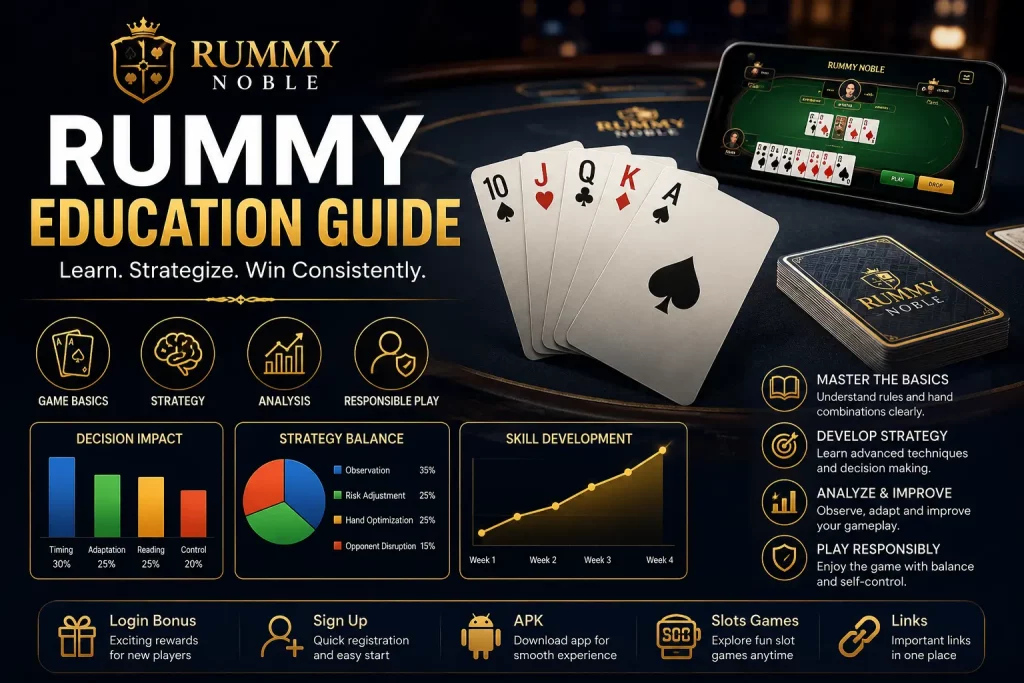
Why Education Matters in Online Rummy Platforms
Modern platforms such as Rummy Noble are designed to support structured learning before real gameplay begins. This is especially important for new users who may be unfamiliar with digital card environments.
Education improves:
- Confidence during gameplay
- Understanding of rules and variations
- Ability to avoid common beginner mistakes
- Long-term strategic thinking
Most beginners underestimate how much decision-making affects outcomes. A single incorrect discard or misread sequence can completely change the direction of a round. Education reduces these errors significantly.
Additionally, many users discover the platform through onboarding flows that include Login Bonus, Sign Up incentives, APK-based mobile access, and navigation into Slots Games Links sections. While these features are part of platform engagement, they are secondary to understanding gameplay itself.
The Learning Structure on Rummy Platforms
A well-designed Rummy education system is usually divided into progressive stages. Each stage builds upon the previous one, ensuring that users develop skills gradually instead of overwhelming them with advanced strategies too early.
- Beginner Level – Understanding rules and card values
- Intermediate Level – Learning sequences and sets formation
- Advanced Level – Strategy development and opponent reading
This structured progression ensures that players do not skip essential fundamentals.
Rummy Education Progress System
| Level | Focus Area | Outcome |
|---|---|---|
| Beginner | Rules, Card Values, Game Structure | Basic understanding of gameplay flow |
| Intermediate | Sequences, Sets, Card Grouping | Ability to build valid hands consistently |
| Advanced | Strategy, Probability, Opponent Analysis | Competitive-level decision making |
| Expert | Psychological Play, Risk Control | High-level strategic advantage |
Key Skills Developed in Early Learning
The first stage of Rummy education focuses on building mental clarity and pattern recognition. Beginners are trained to identify:
- Which cards are useful for sequences
- Which cards should be discarded early
- How to avoid breaking potential combinations
- When to switch strategy during gameplay
This early learning phase is crucial because it forms the cognitive foundation for all future gameplay decisions.
Without this foundation, players often struggle with inconsistency and reactive decision-making rather than proactive strategy.
Transition from Learning to Real Gameplay
Once players understand the basic rules and structures, they begin transitioning into real gameplay environments. This transition is carefully designed to ensure that users are not overwhelmed.
At this stage, platforms typically introduce:
- Practice tables with no pressure
- Tutorial-based matches
- Gradual difficulty scaling
- Basic reward systems
This ensures that players build confidence before entering competitive environments.
The Role of Strategy in Education
While beginners focus on rules, early strategy development starts almost immediately. Even simple decisions like whether to pick from the open deck or closed deck can influence long-term outcomes.
Players are encouraged to think ahead:
- What cards are likely still in play
- What combinations opponents might be building
- Whether holding a card is beneficial or risky
These thinking patterns distinguish casual players from strategic players.
How Gameplay Actually Evolves During a Round
In the early stage of a round, players usually experiment with different combinations, holding a wider range of cards to explore possible sequences. As the round progresses, the focus becomes more precise, and decisions begin to tighten around potential winning structures.
Mid-game is where most strategic errors happen. Players often become too attached to incomplete sequences or fail to notice what opponents are discarding. This stage requires attention and patience rather than speed.
In the final stage of a round, the entire mindset changes again. The goal is no longer exploration but optimization—removing unnecessary risk and preparing for a valid declaration.
Strategic Decision-Making in Real Time
What makes Rummy particularly interesting is that every decision has both an immediate and long-term impact. A card that seems useless in the moment may later become critical for an opponent’s sequence. This creates a constant layer of risk evaluation.
Experienced players do not simply react to their own hand. Instead, they observe patterns in the table: repeated discards, hesitation from opponents, or sudden changes in drawing behavior. These signals often reveal more than the cards themselves.
Over time, this develops into a kind of intuitive reasoning, where decisions are made not only based on what is visible but also on what is likely hidden.
In-Game Decision Structure
| Game Phase | Player Focus | Strategic Behavior |
|---|---|---|
| Opening Phase | Exploration of possible combinations | Holding flexible cards and testing sequences |
| Middle Phase | Stabilization of hand structure | Reducing unnecessary cards and focusing on progress |
| Closing Phase | Final optimization | Eliminating risk and preparing declaration |
| Critical Decision Moments | Reaction to opponent moves | Adaptive strategy based on visible patterns |
Risk Awareness and Hidden Information
One of the most important aspects of gameplay is understanding that information is incomplete. You only see your own hand and partial signals from opponents. This creates a constant uncertainty where every decision involves probability, not certainty.
Players often misjudge situations by assuming their current hand is strong enough, without considering how quickly opponents might complete their combinations. This is where most losses occur—not from bad cards, but from misread situations.
A strong player continuously updates their internal model of the game based on what is happening in real time.
Adaptive Thinking in Competitive Play
Rummy rewards adaptability more than rigid planning. A strategy that works in one round may fail completely in another if opponents behave differently. Because of this, successful players remain flexible in their approach.
Instead of committing too early to a single sequence, they allow the game to evolve. This reduces risk and increases the chance of adjusting to unexpected developments.
Adaptability becomes especially important in the later stages of the game, where one incorrect decision can determine the outcome.
Decision Impact on Gameplay
Why Observation Becomes a Core Skill
Observation in Rummy is not passive—it is active interpretation. Players are constantly reading subtle patterns such as hesitation, repeated card types, or changes in drawing behavior.
These observations slowly build a mental map of the game state. Even though no opponent’s hand is visible, patterns often reveal what is likely happening behind the scenes.
Over time, this skill becomes automatic, allowing experienced players to make faster and more accurate decisions without overthinking each move.
Transition Toward Advanced Strategy
Once players become comfortable with mechanics and adaptive decision-making, they naturally begin developing deeper strategic instincts. At this point, gameplay becomes less about reacting and more about controlling the flow of the game.
This includes influencing what opponents can safely discard, anticipating their next moves, and positioning oneself for optimal end-game decisions.
In advanced Rummy play, the game starts to feel less like a simple card arrangement exercise and more like a continuous reading of intent, probability, and human behavior. What separates experienced players from everyone else is not how quickly they complete combinations, but how accurately they interpret the flow of information across the table.
At this level, every move carries context. A discarded card is no longer just a disposal decision; it becomes a signal that can either mislead or reveal strategy. The entire round becomes a layered system where visible actions hide deeper intentions. Platforms like Rummy Noble naturally amplify this dynamic because real-time decisions and competitive pressure force players to think beyond their own hand.
One of the most important shifts in thinking is that a strong hand is not defined by what it contains at a given moment, but by how flexible it remains over time. Experienced players avoid locking themselves into a single outcome too early. Instead, they preserve multiple possibilities for as long as possible, adjusting their direction based on what unfolds during play.
This kind of adaptability is closely tied to observation. Skilled players continuously track which cards have already left the game, how often certain suits appear in discards, and whether opponents are changing their drawing behavior. These subtle patterns often reveal more than any single action. Over time, this builds an internal model of the match that guides decision-making without requiring conscious calculation every time.
Risk perception also becomes significantly more refined. Rather than labeling moves as simply “safe” or “dangerous,” experienced players evaluate risk in relation to timing and context. A card that appears risky early in a round may become strategically irrelevant later, while a seemingly harmless decision can create long-term disadvantages if it assists an opponent’s progression.
Because of this, emotional discipline plays a major role in performance. Many mistakes happen when players react too quickly to pressure or attempt to force completion instead of allowing the game to develop naturally. The most consistent results come from controlled pacing, where decisions are made deliberately even under time constraints.
The mental workload increases as the match progresses. Players are not only managing their own combinations but also maintaining an ongoing interpretation of what others might be building. This dual-layer thinking creates a constant balance between self-optimization and opponent disruption.
Advanced Decision Logic in Rummy
| Game Situation | Player Interpretation | Resulting Action Pattern |
|---|---|---|
| Early uncertainty in hand structure | Keep multiple possible combinations open | Avoid committing too early to one sequence |
| Repeated opponent discards of similar value cards | Opponent likely targeting a specific sequence | Adjust discards to avoid assisting that pattern |
| Mid-round stabilization of cards | Evaluate which combinations are realistically completing | Begin narrowing focus toward strongest structure |
| Approaching end of round | Opponent pressure increases risk sensitivity | Prioritize minimizing exposure over expansion |
Another important layer of high-level play is the ability to delay decisions that feel urgent. Instead of immediately reacting to a useful draw or an opponent’s move, experienced players often pause mentally to reassess whether the action improves long-term positioning. This restraint often creates a noticeable advantage over time.
Consistency in performance emerges from this combination of observation, timing control, and emotional stability. The strongest players are not those who avoid risk entirely, but those who understand exactly when risk becomes productive rather than harmful.
Strategic Behavior Distribution
What this distribution highlights is that successful gameplay is not dominated by a single approach. Instead, it is a shifting balance where observation and adaptation consistently take priority over rigid planning.
As players gain more experience, these behaviors become automatic. Decisions are no longer calculated step by step but emerge naturally from pattern recognition built over time.
At this point in the learning journey, Rummy is no longer viewed only as a game of cards, but as a structured environment where skill, discipline, and decision-making come together. Players who reach this level already understand sequences, strategy, and risk control. The final step is learning how to engage with the platform responsibly while maintaining consistency in performance over time.
On platforms like Rummy Noble, the experience is designed not only around gameplay but also around user progression. This includes onboarding systems, reward structures, practice environments, and educational layers that help players refine their skills gradually rather than forcing immediate competition.
Understanding the platform ecosystem becomes just as important as understanding the game itself. Elements such as Login Bonus systems, Sign Up flows, APK access for mobile users, Slots Games sections, and navigation Links are part of the broader digital structure that keeps users engaged. However, these features should always be seen as secondary to actual gameplay understanding and skill development.
A well-developed player recognizes that long-term improvement depends on balance. Over-engagement or emotional decision-making often leads to inconsistent results, while structured play and controlled pacing support better outcomes over time.
Responsible Engagement and Player Awareness
Responsible play is a key component of sustainable gaming behavior. In skill-based environments, discipline matters as much as knowledge. Players who manage their time, expectations, and focus tend to perform more consistently than those who play impulsively.
One of the most important ideas in long-term gameplay is that every session should be approached with clarity. Instead of reacting emotionally to wins or losses, experienced players treat each round as an independent decision cycle. This prevents pattern-based mistakes where previous outcomes influence current decisions.
Another important aspect is understanding personal limits. While platforms provide accessibility and engagement tools, it is ultimately the player’s responsibility to maintain control over their participation. This includes recognizing when to pause, when to continue, and when to shift focus away from gameplay entirely.
Building Long-Term Skill Consistency
Consistency in Rummy does not come from occasional strong games but from repeated, structured decision-making. Over time, players develop internal systems for evaluating risk, reading opponents, and managing their own hand progression.
What often separates average players from strong ones is not knowledge of rules, but the ability to apply that knowledge under pressure. Emotional stability plays a major role here, especially in close or uncertain rounds.
As experience grows, decisions become less reactive and more intuitive. This does not mean guessing—it means recognizing familiar patterns quickly and responding without hesitation. That type of instinct is built through repetition and reflective learning.
Responsible Play Framework
| Focus Area | Player Behavior | Long-Term Effect |
|---|---|---|
| Time Management | Controlled session length | Improved focus and reduced fatigue |
| Emotional Control | Neutral response to wins/losses | More stable decision-making |
| Strategic Discipline | Consistent application of logic | Higher accuracy in gameplay decisions |
| Self-Awareness | Understanding personal limits | Reduced impulsive actions |
When viewed as a whole, Rummy becomes a structured system of decision-making under uncertainty. Every round is a sequence of micro-decisions that collectively determine the outcome.
Players who succeed consistently are those who treat the game as an evolving process rather than isolated rounds. They learn from patterns, adapt to different opponents, and maintain discipline even when the game becomes unpredictable.
The most important realization at this stage is that mastery is not a fixed destination. It is a continuous process of refinement where each session contributes to better understanding and sharper decision-making.
FAQ — Rummy Noble Education Guide
What is the main goal of Rummy education?
The main goal is to help players understand rules, develop strategic thinking, and improve decision-making under uncertainty.
Is Rummy only based on luck?
No, Rummy is a skill-based game where long-term success depends on strategy, observation, and risk management rather than luck alone.
Why is emotional control important in Rummy?
Emotional control helps prevent impulsive decisions, which are one of the main causes of inconsistent performance.
How does experience improve gameplay?
Experience helps players recognize patterns faster, make better predictions, and respond more effectively under pressure.